Maybe it's because I too left a warm place for a rainy place that the old stories of Hawaiians in the northwest have really begun to interest me.
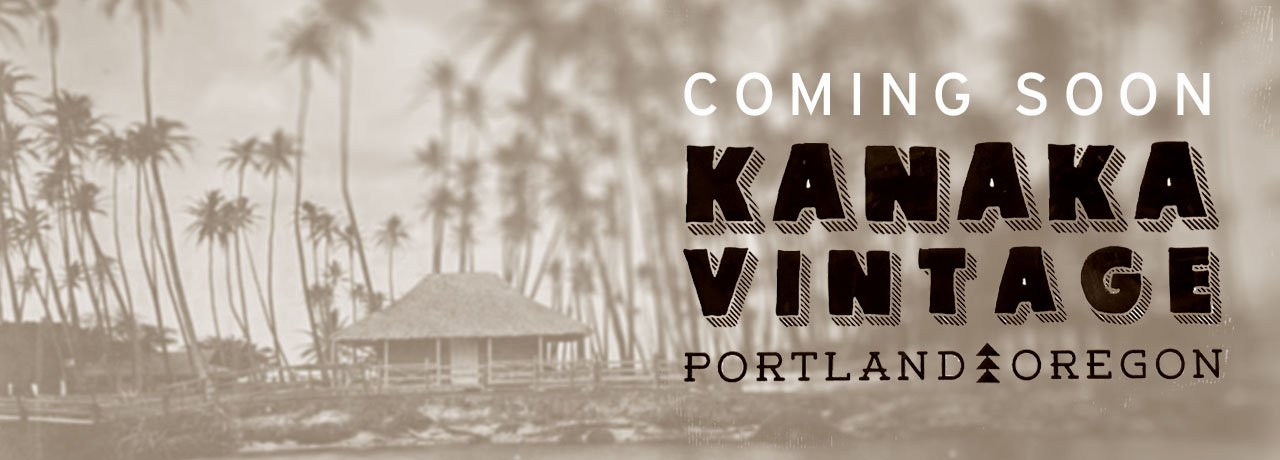
Today I researched Hawaiian history in the PNW at the Oregon Historical Society to see what they had on file. It wasn't a lot, one skinny envelope in a library of files, but what I did find was great. Just over the river from me, in Vancouver Washington, hundreds of Hawaiians or "Kanakas" as they called themselves (which simply means "human being" in Hawaiian) lived and worked in Kanaka Village at Fort Vancouver.

As early as 1787, Hawaiians began traveling aboard the English ships coming through the Islands. They came to work mostly in the fur trade and also as indentured servants for the King in return for goods. By 1842, there were over 300 Hawaiians working for Hudson's Bay Trading alone.
Hawaiians could swim, an exceptional skill at the time, even among sailors. Their strength and size served them well in the backbreaking work of portage, hunting, sailing, canoeing, clearing land, farming, and logging. Their willingness to learn and outstanding work ethic made them high in demand. In an era when long distances were traversed by river and sea, Islanders were at home on the water, and in it, too. By 1898 when Hawai`i was annexed, thousands of Hawaiians had been employed in the Pacific Northwest.
One man in particular, Naukane - or John Coxe (or Cox) as he was called by his English boat mates, arrived in Astoria in 1811 to oversee the Hawaiians who had been sent to work in Oregon. He was a well rounded man, having supposedly witnessed the demise of Captain Cook and worked on King Kamehameha I's royal court as a hired observer. Upon arrival in Astoria, he was quickly employed by North West Company and accompanied surveyor and mapmaker, David Thomson by canoe who portaged halfway across the continent to the company's supply depot and center at Fort William (Ontario) on Lake Superior.

“On Mr. Thompson’s departure, Mr. Stuart gave him one of our Sandwich Islanders, a bold and trustworthy fellow, named Cox, for one of his men, a Canadian ... Cox, again, was looked upon by Mr. Thompson as a prodigy of wit and humour” (Ross, 115).
While writing his memoirs several decades later, Thompson recalled Coxe’s physique and desire to master English rather than his sense of humor: “I exchanged a Man ... weak for the hard labor of ascending the River, for a powerful well made Sandwich Islander, (whom we named Coxe, from his resemblance to a seaman of that name;) he spoke some english, and was anxious to acquire our language” (Thompson, Travels, iii, 281).
In 1812 the ship "Isaac Todd" took Naukane to England. In 1813 he had returned to the Pacific Northwest. Naukane returned to Hawaii in 1815 and then was sent back to England by King Kamehameha (Liholiho) a second time. He moved again to the Pacific Northwest in 1827 where he worked at Fort Vancouver, raising pigs for Hudson's Bay Company. He died of tuberculosis sometime around 1840 and is buried somewhere near Fort Vancouver.

What strikes me about Naukane was his courage to leave his homeland, travel extensively (and successfully), then finally decide to settle in a cold, rainy place. Islanders are amazing explorers and often travel great distances to unknown lands. I think often of returning to Hawai`i and always the cost of living and traffic (!) turn me back. There's over 50,000 persons of Hawaiian decent in Washington today and I wonder if they all feel completely at peace living so far from home. I think I will look into finding his gravsite. I don't know if Fort Vancouver recognizes him at all.